How Payment & Escrow Works on Vhagar Market
Payment on Vhagar is where the market's design does its best work. Every transaction routes through a multi-signature escrow system that holds funds until both parties agree the deal is done — or until a dispute forces a resolution. Understanding this flow is the difference between a smooth purchase and a costly mistake.
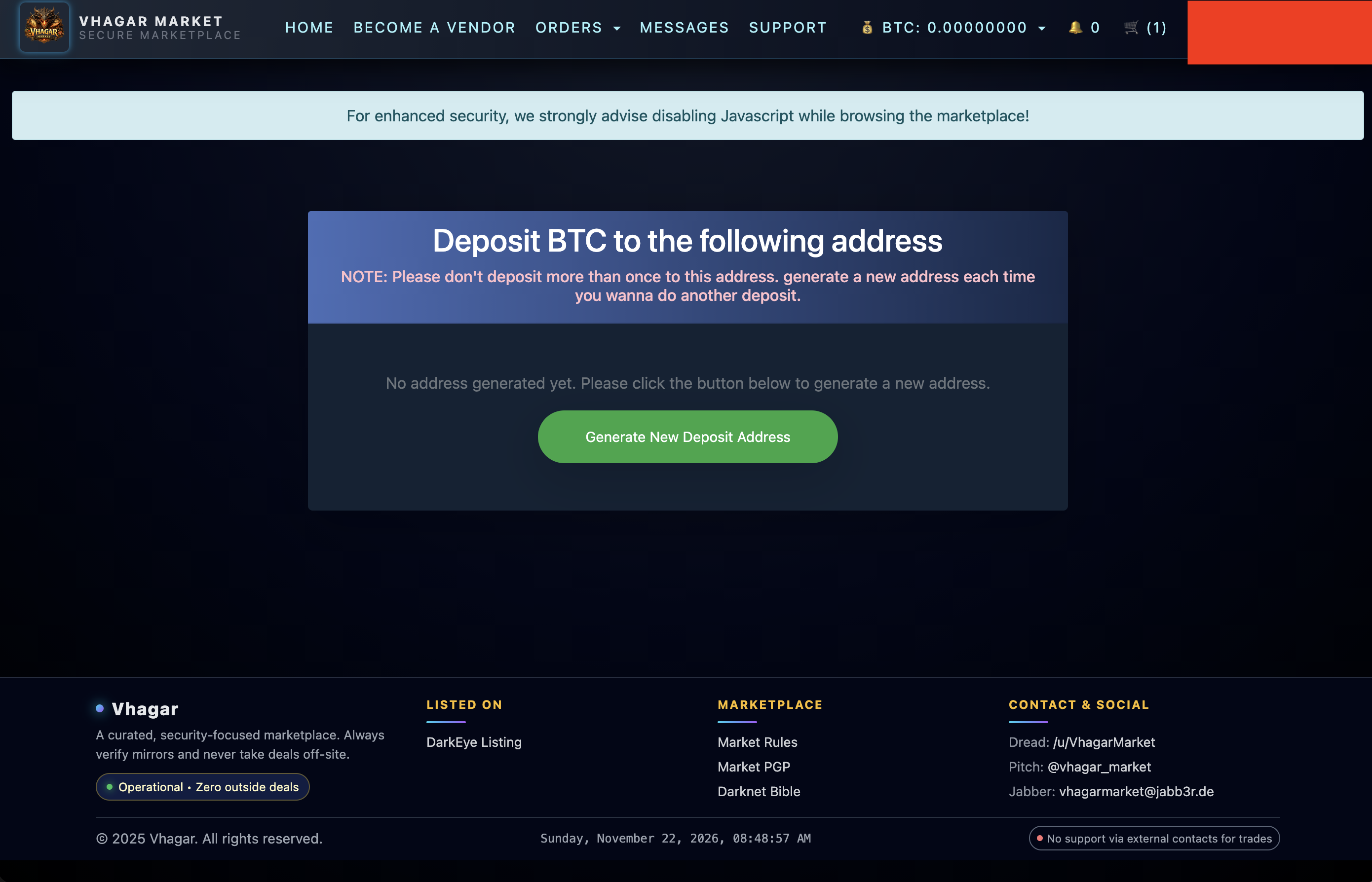
Funding Your Market Wallet
Bitcoin vs. Monero
Vhagar accepts both BTC and XMR. The choice matters:
| Bitcoin (BTC) | Monero (XMR) | |
|---|---|---|
| Privacy | Transparent ledger — amounts and addresses are public | Private by default — amounts and counterparties hidden |
| Speed | ~10 min per confirmation; markets usually require 1–3 | ~2 min per block; typically 10 confirmations ≈ 20 min |
| Fees | Variable; can spike during congestion | Low and stable (~0.0001 XMR typical) |
| Market support | Universal — every vendor accepts | Widely accepted; confirm per-listing |
| Best for | Convenience, larger orders, vendor compatibility | Maximum financial privacy |
The Escrow Flow
Order generates a unique deposit address
Each order gets its own escrow address — a multi-signature wallet requiring market + buyer + vendor keys to move funds.
You send payment to the escrow address
Send the exact total shown at checkout. The order page tracks confirmations in real time.
Escrow confirms and notifies the vendor
After enough confirmations, the market marks the order funded and the vendor begins fulfillment.
You receive the goods
Physical items ship stealth-packed; digital goods arrive via encrypted message or download link.
You finalize — funds release to vendor
Finalizing is your signature on the deal. It releases escrow to the vendor and closes the order.
Dispute path if needed
Wrong item, non-delivery, or vendor silence → open a dispute before finalizing. Escrow holds funds until resolution.
Protecting Your Funds
- Exact amounts only. Send precisely what checkout shows. Overpayments may not be recoverable.
- Unique addresses. Every order gets a fresh deposit address. Never reuse one — it breaks the escrow linkage.
- Verify before sending. Double-check the address character-by-character or use the market's copy button. Clipboard hijackers swap addresses.
- Save transaction IDs. Your TXID is proof of payment. Screenshot or record it before leaving the page.
- Watch the confirmation count. "Payment sent" isn't "order active" — wait for the market's own status update.
Market Fees
Vhagar charges standard darknet market fees — typically a small percentage on completed orders plus a deposit fee when funding your wallet. Fees appear at checkout before you commit, so there are no surprises. Factor them into your budget for small orders where a flat-ish percentage hits harder.
If Something Goes Wrong
Escrow's entire purpose is the unhappy path. If a vendor disappears mid-order, the escrowed funds remain locked and a dispute can route them back to you. If the market itself goes offline, escrowed funds may be unrecoverable — that's the residual risk no escrow can eliminate. This is why vendor reputation and market longevity matter more than price.